
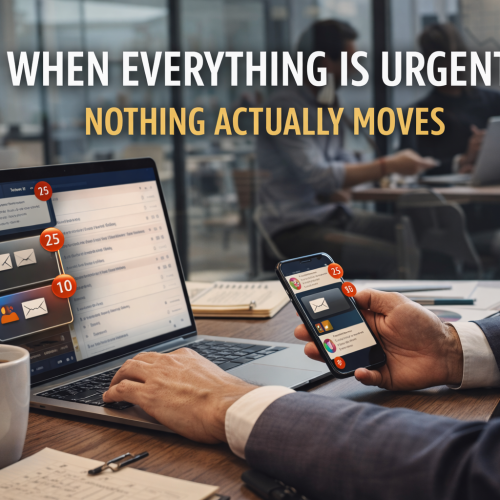
“When Everything Is Urgent, Nothing Actually Moves”
Let’s be honest for a second. Every growing company hits this phase, and when it does, it’s almost hard to spot at first.
The inbox is stacked. Slack is nonstop. Calendars are filled before people even have time to think. Everyone is responsive, everyone is busy, and from the outside it looks like things are running at full speed.
But underneath that surface, something starts to drag.
Projects take longer than they should. Decisions get pushed. The work that actually drives the business forward quietly loses traction.
Nothing is technically broken. But nothing is really accelerating either.
That’s the urgency illusion. And it’s one of the most expensive patterns a company can fall into.
Here’s the part most people don’t realize.
Urgency feels like progress because it creates constant motion. You’re replying, reacting, checking things off, staying visible. It gives the impression that the system is working.
But urgency doesn’t prioritize impact. It prioritizes noise.
And there’s real data behind this. Studies from the American Psychological Association show that frequent interruptions can cut productivity by up to 40 percent. Not because people stop working, but because their brains never fully lock into meaningful work. Every interruption forces a reset, and those resets add up fast.
So what you end up with is a team that’s active all day, but rarely in deep focus long enough to move anything substantial forward.
This is where the real tension sits. Urgent work and important work are not the same thing.
Urgent work asks for attention now. Important work builds long term value.
The problem is urgency is loud. It’s the Slack ping, the quick email, the “can you look at this real fast.” Important work is quieter. It’s strategic decisions, system improvements, long term thinking. It doesn’t scream for attention, so it gets pushed.
Over time, teams start optimizing for completion instead of impact. They choose what can be finished quickly over what actually matters.
That’s how you get motion without momentum.
And here’s something most leadership teams don’t catch early enough. Urgency culture is almost never intentional.
It usually starts at the top, but not in an obvious way.
A founder who responds instantly to everything. A manager who expects quick turnarounds. A leadership team that rewards speed over depth.
No one says “we value urgency over strategy,” but the behavior signals it anyway.
Teams pick up on that fast.
They start interrupting their own focus to stay responsive. They escalate decisions instead of working through them. They default to quick answers instead of thoughtful ones.
The system becomes reactive. Not because people lack discipline, but because the environment is training them to behave that way.
There’s also a cognitive cost here that most people underestimate.
It can take over twenty minutes to fully return to deep focus after an interruption. Not a few seconds. Not a quick reset. Twenty minutes.
Now multiply that across a day filled with messages, meetings, and constant context switching.
You don’t just lose time. You lose depth. You lose the kind of thinking that actually solves problems and moves strategy forward.
From the outside, urgent environments can look impressive. Fast replies. Active channels. Everyone engaged.
But activity is not the same as effectiveness.
What actually starts slipping are the things that require sustained attention. Strategic initiatives slow down. Long term improvements stall. Complex problems stay unsolved longer than they should.
And here’s the subtle tradeoff teams are making all day without realizing it.
They’re choosing responsiveness over thinking. Meetings over building. quick wins over meaningful progress.
Not because they want to, but because the system rewards it.
Healthy organizations don’t eliminate urgency. They just get very clear about where it belongs.
Not everything deserves an immediate response. Not every question should interrupt focus. Not every task carries the same weight.
The companies that scale well build clarity around three things. What truly needs action now. What requires deep, uninterrupted focus. What can wait.
That clarity alone changes behavior.
Because once people know what actually matters, they stop reacting to everything else.
And this is where leadership plays the biggest role.
The most powerful shift is not adding more process or more tools. It’s asking a better question.
What actually deserves urgency?
When leaders answer that clearly and consistently, everything starts to recalibrate.
The environment gets quieter. Focus improves. Decisions get sharper.
And ironically, progress speeds up.
Because energy is no longer scattered across everything. It’s directed toward the work that actually moves the business forward.
Most organizations don’t struggle because people aren’t working hard enough.
They struggle because effort is fragmented.
Urgency pulls attention toward whatever is loudest. Leadership has to pull it back toward what matters.
That difference is what separates busy teams from effective ones.
And once a team learns how to protect its attention, momentum tends to come back faster than expected.