
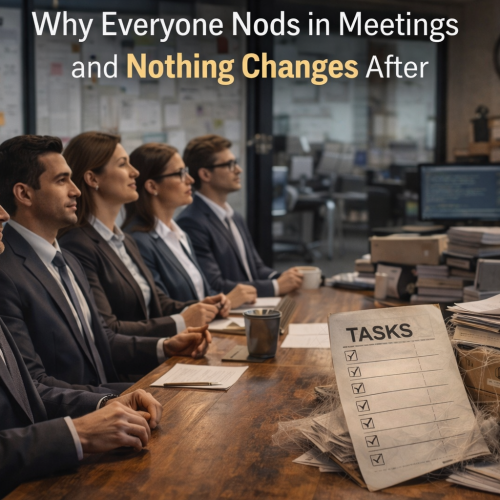
“Agreement Feels Like Progress. Alignment Creates Execution”
There is a moment almost every founder has experienced.
The meeting feels strong.
The strategy makes sense.
Energy is high.
Everyone is nodding.
You walk out thinking,
We are aligned.
And then nothing changes.
A week passes.
Momentum fades.
Follow through feels thin.
From the outside it looks like a motivation problem.
Most of the time, it is not.
It is the alignment illusion.
Agreement Feels Like Progress
Agreement is comfortable.
No one pushes back.
No one raises tension.
No one asks hard questions.
The room feels unified.
But agreement only means no one objected out loud.
Alignment means people know exactly what they are responsible for next.
Those are very different outcomes.
A team can agree with the strategy and still be unclear about execution.
And unclear execution never creates momentum.
Why People Nod Instead of Question
There is a psychological layer most leaders overlook.
In group settings, people default toward harmony.
No one wants to be the person who slows the room down.
No one wants to appear confused when others seem confident.
No one wants to challenge a leader in a high energy moment.
So they nod.
Not because they fully understand.
Not because they fully commit.
But because it feels safer than friction.
The problem is friction is often where clarity lives.
The Strategy to Execution Gap
Most meetings focus heavily on what and why.
What are we doing.
Why does this matter.
Far fewer meetings clarify who and how.
Who owns this outcome.
What does success look like.
What tradeoffs are acceptable.
What decisions do not require another meeting.
Without those answers, strategy remains abstract.
Abstract ideas do not move companies.
Ownership does.
“When Everyone Agrees And Nobody Owns It, Momentum Disappears”
Shared Language Is Not Shared Understanding
Leaders often mistake shared vocabulary for shared clarity.
Everyone uses the same words.
Growth.
Urgency.
Alignment.
Customer first.
But shared language does not guarantee shared definition.
If five people define success slightly differently, execution fragments quietly.
It looks aligned on the surface.
Underneath, progress splinters.
Why Momentum Disappears Quietly
Momentum rarely collapses dramatically.
It fades slowly.
Tasks are assigned loosely.
Follow up meetings are scheduled.
Clarifications are requested.
Deadlines stretch.
No one openly resists.
The initiative simply loses oxygen.
That is what happens when alignment is assumed instead of engineered.
The Cost of Undefined Ownership
When ownership is vague, accountability becomes collective.
Collective accountability sounds collaborative.
In practice, it diffuses responsibility.
If everyone owns it, no one fully owns it.
And when no one fully owns it, decisions slow.
Escalation increases.
Execution hesitates.
Leaders interpret this as lack of urgency.
Often it is lack of structural clarity.
What Real Alignment Looks Like
Real alignment is specific.
There is a named owner.
There is a defined outcome.
There is a measurable result.
There is a timeline.
There is clarity around what does not need approval.
People leave the meeting not just inspired, but instructed.
They know what to do next without another conversation.
That is when meetings create movement instead of noise.
The Shift From Nodding to Commitment
The question that changes everything is simple.
Before we leave, who owns what and what happens next.
That layer of specificity prevents weeks of drift.
It surfaces confusion immediately.
It replaces assumed agreement with defined accountability.
It turns energy into execution.
The Real Alignment Problem
Your team is not failing to execute because they lack motivation.
They are often operating inside an illusion.
Agreement without ownership.
Strategy without decision rights.
Vision without defined next steps.
When leaders close that gap, something shifts.
Meetings become shorter.
Execution becomes sharper.
Momentum sustains itself.
Because alignment is no longer a feeling.
It is a structure.
And structured alignment is what moves companies forward.