
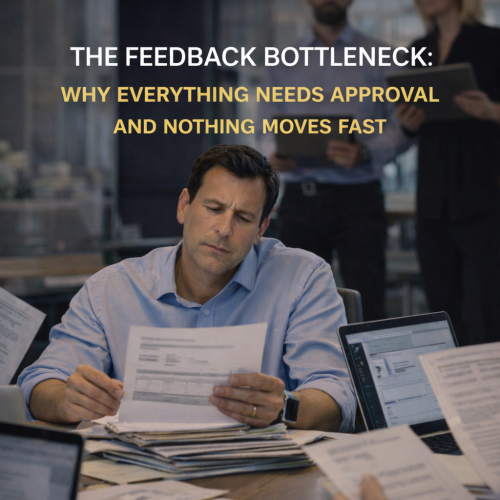
There is a moment inside almost every growing company where something starts to feel off.
Work is happening.
The team is capable.
Projects are in motion.
But everything seems to slow down at the same place.
Before anything ships
Before anything finalizes
Before anything moves forward
It needs one more look.
One more review.
One more opinion.
One more round of feedback.
And over time, that pattern turns into a bottleneck.
That’s the feedback trap.
Feedback Starts as a Strength
Feedback is essential.
It improves quality.
It sharpens thinking.
It prevents mistakes.
Early on, it makes the business better.
Leaders are close to the work.
Teams are still learning.
Alignment matters more than speed.
So feedback becomes part of the system.
And at that stage, it works.
When Feedback Becomes a Requirement
The shift happens quietly.
Feedback stops being helpful.
And starts becoming required.
Nothing moves without it.
Documents wait for review.
Decisions wait for input.
Work waits for approval.
The intention is good.
But the effect is different.
The system begins to slow.
The Illusion of “Just One More Look”
There is a phrase that sounds harmless.
Let’s take one more look.
It feels responsible.
It feels thorough.
It feels like quality control.
But multiplied across an entire organization, it creates friction.
Every decision stretches.
Every timeline expands.
Every deliverable slows.
Because every step now includes a pause.
And those pauses add up.
Why Teams Start Depending on Feedback
Teams are not trying to avoid responsibility.
They are adapting to the system.
When feedback is expected, feedback becomes necessary.
People start asking earlier.
They start checking more often.
They start waiting instead of deciding.
Not because they lack confidence.
Because they are trying to avoid being wrong.
Over time, a pattern forms.
Nothing is final until someone else approves it.
The Invisible Permission Loop
This is where things start to break down.
A team member creates something strong.
Instead of finishing it, they send it for review.
The leader responds quickly.
Approves it.
Makes a few edits.
Work moves forward.
It feels efficient.
But what is actually being built is dependence.
The team is learning one thing.
Do not finalize without approval.
That is the invisible permission loop.
And it quietly slows everything.
The Cost of Over-Reviewing
When everything requires feedback, several things happen.
Decision speed drops.
Ownership weakens.
Confidence decreases.
People stop trusting their own judgment.
They rely on validation.
They hesitate before acting.
And hesitation slows execution more than almost anything else.
Research on decision fatigue shows that unclear authority and constant validation loops increase cognitive load and delay action.
What looks like caution is often structural dependency.
Why Leaders Get Stuck Here
From a leadership perspective, this pattern is hard to see.
Feedback feels like involvement.
It feels like staying connected to the work.
It feels like maintaining quality.
But there is a hidden tradeoff.
The more everything flows through you, the slower the system becomes.
Not because you are the problem.
Because the system is built around you.
The Difference Between Feedback and Approval
This is where clarity matters.
Feedback should improve the work.
Approval should not control the flow of it.
When those two blur together, everything gets routed through the same bottleneck.
Strong systems separate them.
Feedback is available.
Approval is limited.
Not every decision requires it.
Not every piece of work needs it.
That distinction creates speed.
What High Performing Teams Do Differently
Teams that move quickly do something simple.
They define decision boundaries.
They clarify what requires input.
They define what does not.
They trust people within those boundaries.
Work moves without constant review.
Decisions happen closer to where the work lives.
Feedback becomes optional.
Not required.
And that shift changes everything.
The Leadership Shift That Unlocks Speed
The most important question is simple.
Where does feedback actually add value
Not where it feels helpful.
Not where it feels safe.
Where it truly improves outcomes.
Everything else should move without it.
That clarity removes unnecessary steps.
It gives teams space to act.
And when people are trusted to decide, they move faster.
The Real Problem Behind Slow Teams
Most teams are not slow because they lack skill.
They are slow because they are waiting.
Waiting for input.
Waiting for approval.
Waiting for direction.
When those waiting points are removed, speed returns naturally.
Because the work was never the problem.
The system was.
The Question That Changes Everything
There is one question that reveals the bottleneck.
Does this actually need feedback, or are we just used to asking for it
When leaders start answering that honestly, the system shifts.
Work moves faster.
Ownership strengthens.
And the organization becomes less dependent on constant input.
Because feedback is no longer a gate.
It becomes what it was meant to be.
A tool.