
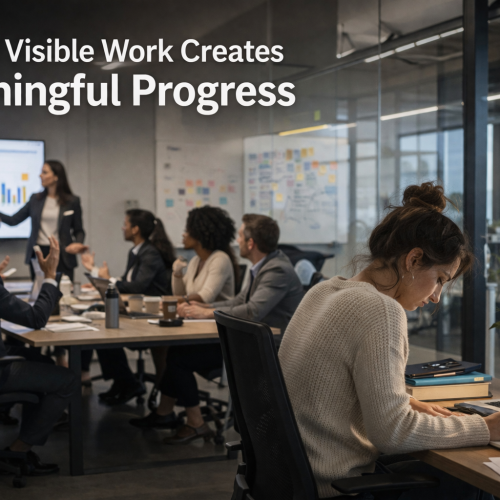
There is a shift that happens inside almost every growing company.
It doesn’t happen overnight.
It builds slowly.
People start paying attention to what gets noticed.
What gets discussed in meetings.
What gets praised in updates.
What leadership reacts to quickly.
And without realizing it, behavior starts to change.
Work begins to optimize for visibility instead of value.
That’s the visibility trap.
Visibility Feels Like Progress
Visible work creates a signal.
There are updates.
There is activity.
There is something to show.
It feels productive.
It feels like things are moving.
But visibility is not the same as impact.
A long meeting can look productive.
A detailed update can feel important.
A quick win can create momentum.
But none of those guarantee that the business is actually moving forward in a meaningful way.
They just guarantee that the work is seen.
Why Teams Naturally Optimize for What Gets Noticed
People are not trying to game the system.
They are responding to it.
When visibility is what gets recognized, visibility becomes the priority.
Quick responses get attention.
Frequent updates get praise.
Visible effort gets rewarded.
So teams adjust.
They focus on what can be shown.
What can be communicated.
What can be acknowledged.
Not necessarily what creates the most value.
The Quiet Work That Gets Ignored
The most important work in a business is often the least visible.
Deep thinking.
System improvements.
Strategic decisions.
Long term problem solving.
This kind of work does not produce immediate signals.
It does not show up in quick updates.
It does not create instant recognition.
So it gets delayed.
Not because it is unimportant.
Because it is not urgent and it is not visible.
How Performance Turns Into Theater
Over time, something subtle starts to happen.
Work becomes performative.
Updates get longer.
Meetings get fuller.
Communication increases.
It looks like alignment.
It looks like collaboration.
But underneath it, the system is shifting.
People are optimizing for appearing productive instead of being effective.
This is where performance turns into theater.
And theater does not drive results.
Why Leaders Miss This Pattern
From the outside, everything can look strong.
People are active.
There is communication.
There are visible outputs.
It creates a sense of progress.
But the real signal is not in what is visible.
It is in what is moving.
Are the right problems being solved.
Are the important initiatives advancing.
Is the business actually improving.
If those answers are unclear, visibility may be masking a deeper issue.
The Hidden Cost of the Visibility Trap
When visibility becomes the priority, focus fractures.
Teams spend time on updates instead of execution.
They prioritize short term wins over long term value.
They choose work that is easy to show over work that is hard to solve.
The result is subtle but powerful.
The business stays busy.
But progress slows.
What Real Value Actually Looks Like
Value creating work is different.
It is often slower.
It requires focus.
It does not always produce immediate results.
But it compounds.
A system that improves efficiency.
A decision that simplifies complexity.
A solution that prevents future problems.
These things may not be visible in the moment.
But they change the trajectory of the business.
The Leadership Shift That Changes Behavior
Leaders set the signal.
What gets attention.
What gets rewarded.
What gets discussed.
If visibility is rewarded, teams will optimize for visibility.
If impact is rewarded, teams will optimize for impact.
The shift is simple.
Start asking different questions.
What actually moved forward this week.
What problem was solved.
What improved the system.
Not what was done.
But what mattered.
The Difference Between Activity and Progress
Activity is visible.
Progress is measurable.
Activity fills time.
Progress moves the business.
The two can look the same in the short term.
But over time, the difference becomes clear.
One creates motion.
The other creates results.
The Real Problem Behind Busy Teams
Most teams are not lacking effort.
They are misdirecting it.
They are responding to the signals the system gives them.
If the signal rewards visibility, they will produce visible work.
If the signal rewards impact, they will produce meaningful results.
That difference defines how a company operates.
The Question That Refocuses Everything
There is one question that cuts through the noise.
Is this work being done because it matters, or because it will be seen
When that question becomes part of the culture, behavior shifts.
Teams become more intentional.
Work becomes more focused.
And progress becomes clearer.
Because the goal is no longer to look productive.
It is to actually move the business forward.